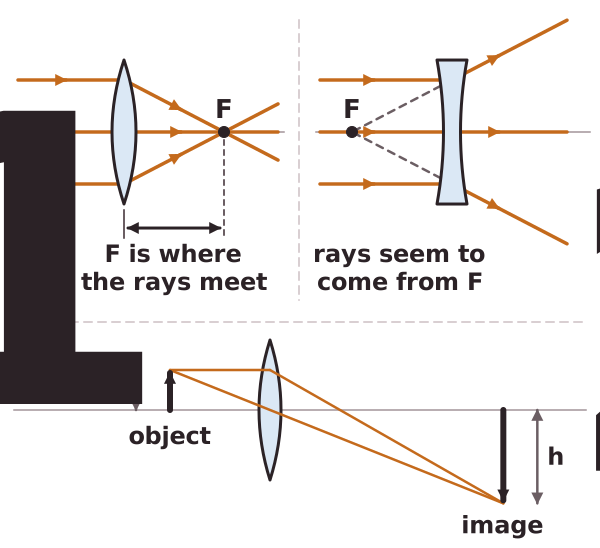
A lens forms an image by refracting light. A convex lens is thicker in the middle and brings parallel rays of light together at a point called the principal focus. The distance from the lens to the principal focus is the focal length. A concave lens is thinner in the middle and spreads parallel rays out. Ray diagrams show how convex and concave lenses form images.
The image from a convex lens can be real or virtual. A real image can be projected onto a screen. The image from a concave lens is always virtual, and it is upright and smaller than the object.
The magnification of a lens is magnification = image height / object height. Magnification is a ratio, so it has no units. Image height and object height must both be measured in mm or both in cm. For example, an object of height 2 mm with an image of height 10 mm has a magnification of 10 / 2 = 5.