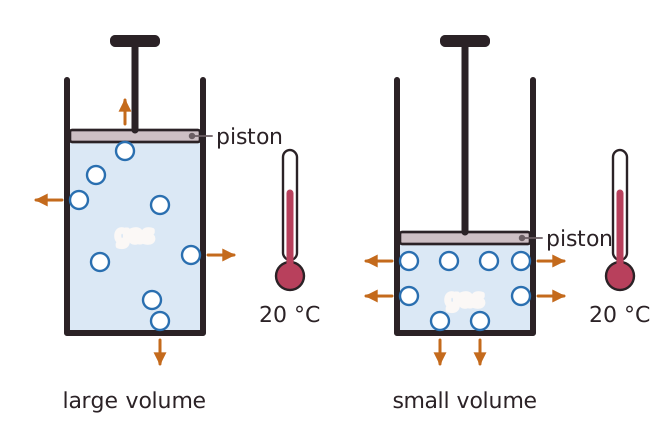
A gas can be compressed or expanded when its pressure changes. The gas pushes on the walls of its container, and on any surface placed in it. The pressure produces a net force that acts at right angles to the surface. The unit of pressure is the pascal, Pa.
The particle model explains what happens when the volume changes. Keep the temperature constant, so the molecules keep the same average speed. If the volume of the container is increased, the molecules have further to travel between collisions, so they hit the walls less often. The pressure decreases. If the volume is made smaller, the molecules hit the walls more often and the pressure increases.
For a fixed mass of gas at constant temperature, the pressure multiplied by the volume is a constant: pressure × volume = constant, or pV = constant. Pressure is in pascals (Pa) and volume is in metres cubed (m3). So if the volume is doubled, the pressure halves, and if the volume is halved, the pressure doubles.
Worked examples: a gas at 100000 Pa is compressed to half its volume at constant temperature, so the new pressure is 200000 Pa. A gas at 150000 Pa and 0.004 m3 is expanded to 0.006 m3. Then p1V1 = 150000 × 0.004 = 600, so the new pressure is 600 ÷ 0.006 = 100000 Pa.