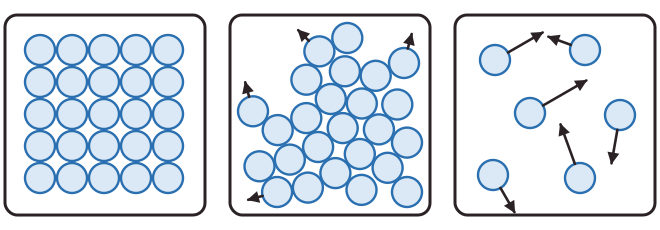
A substance can change between solid, liquid and gas. A solid turns into a liquid by melting, and a liquid turns back into a solid by freezing. A liquid turns into a gas by boiling or evaporating, and a gas turns back into a liquid by condensing. When a solid changes straight into a gas without becoming a liquid first, this is called sublimation.
In every change of state, mass is conserved. The particles are only rearranged, and none are created or lost. If 250 g of ice melts, you get exactly 250 g of water. If 100 g of water boils, the steam that forms has a mass of 100 g, even though it fills a far larger volume.
Changes of state are physical changes. They differ from chemical changes because no new substance is made. If the change is reversed, the material recovers its original properties. For example, water that has been frozen and then melted is the same water as before. In a chemical change, such as burning, new substances form and the original material cannot simply be recovered by reversing the change.