The density of a material tells you how much mass is packed into each unit of volume. It is found with the equation density = mass ÷ volume, or ρ = m ÷ V. Density is in kilograms per metre cubed (kg/m3), mass is in kilograms (kg) and volume is in metres cubed (m3). For example, a block with a mass of 3 kg and a volume of 0.0004 m3 has a density of 3 ÷ 0.0004 = 7500 kg/m3.
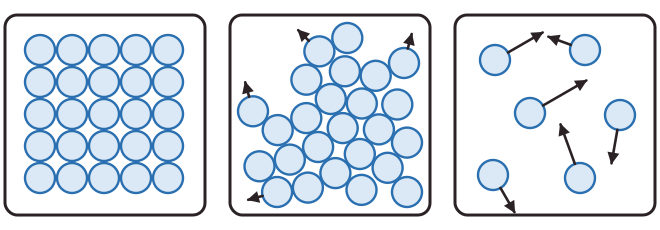
The particle model explains the different states of matter and differences in density. In a solid the particles are closely packed in a regular pattern. In a liquid they are also close together but are arranged randomly and can move past each other. In a gas the particles are far apart and move freely. Because gas particles are so far apart, a gas has a much lower density than a solid or a liquid of the same substance. A solid usually has a higher density than a gas.
When a substance changes state, the number of particles does not change, so its mass is conserved. Its volume does change, so its density changes too.
In required practical 5 you measure density. For a regular solid, measure its dimensions with a ruler, micrometer or Vernier callipers and calculate the volume. For an irregular solid, lower it into a displacement can and measure the volume of water that overflows. For a liquid, pour it into a measuring cylinder to read the volume. Find the mass on a balance, then divide mass by volume.