Newton's First Law. If the resultant force on an object is zero, a stationary object stays stationary and a moving object carries on at the same speed and in the same direction, so at the same velocity. When a vehicle travels at a steady speed, the resistive forces balance the driving force. The velocity (speed and/or direction) of an object only changes if a resultant force acts on it. (Higher tier) The tendency of objects to stay at rest or keep moving at a uniform velocity is called inertia.
Newton's Second Law. The acceleration of an object is proportional to the resultant force acting on it and inversely proportional to its mass. As an equation, resultant force = mass × acceleration, or F = ma, with F in newtons (N), m in kilograms (kg) and a in m/s2. For example, a 1200 kg car with a resultant force of 3000 N has an acceleration of 3000 ÷ 1200 = 2.5 m/s2. (Higher tier) Inertial mass measures how difficult it is to change the velocity of an object, and it is defined as the ratio of force to acceleration.
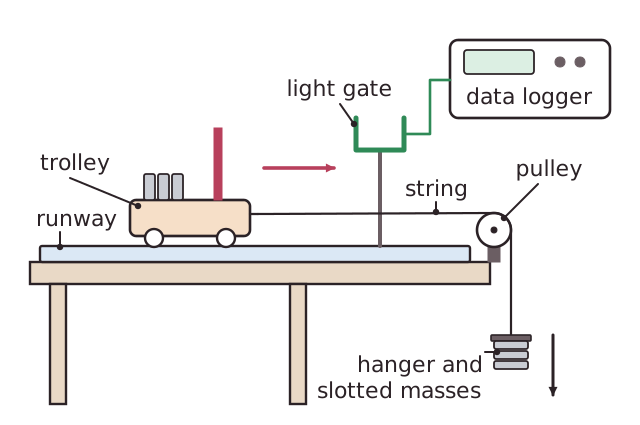
Required practical 7. A trolley is pulled along a runway by a falling mass on a string, and light gates or a data logger measure its acceleration. To vary the force, move masses between the trolley and the hanger, so the total mass stays the same. To vary the mass, keep the force constant and add masses to the trolley. Only one variable is changed each time, and repeat readings improve reliability. The results show that acceleration is proportional to the resultant force and inversely proportional to the mass.
Newton's Third Law. Whenever two objects interact, the forces they exert on each other are equal and opposite. The two forces of a pair act on different objects, so they do not cancel each other out. A book resting on a table pushes down on the table, and the table pushes up on the book with an equal force. This explains equilibrium situations, where the forces on one object balance.