Distance is how far an object moves. It has no direction, so it is a scalar quantity. Displacement is the straight-line distance from the start point to the finish point, together with the direction of that line, for example 5 m north. It is a vector quantity. Speed has no direction (scalar). Velocity is speed in a given direction (vector). A runner who completes a lap of a track has travelled a long distance but has zero displacement. (Higher tier) Motion in a circle has constant speed but changing velocity, because the direction keeps changing.
Typical speeds are walking 1.5 m/s, running 3 m/s, cycling 6 m/s and sound in air 330 m/s. For constant speed, distance travelled = speed × time, or s = vt, with s in metres, v in m/s and t in seconds. Real speeds are rarely constant, so for non-uniform motion we use average speed = total distance ÷ total time. A runner who covers 600 m in 200 s has an average speed of 3 m/s.
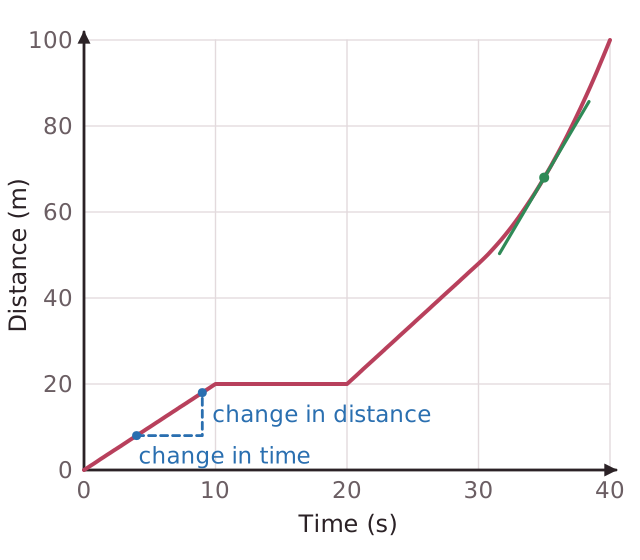
On a distance-time graph the gradient of the line is the speed. A flat line means the object is stationary, a straight sloping line means constant speed, a steeper line means a higher speed and a curve means the speed is changing. (Higher tier) If the object is accelerating, its speed at one moment is the gradient of a tangent drawn to the curve at that time.
Acceleration = change in velocity ÷ time taken, or a = Δv ÷ t, in metres per second squared (m/s2). An object that slows down is decelerating. On a velocity-time graph the gradient is the acceleration. (Higher tier) The area under a velocity-time graph is the distance travelled. For uniform acceleration, v2 - u2 = 2as, where u is initial velocity, v is final velocity and s is distance. For example, a car starting from rest with an acceleration of 2 m/s2 over 25 m reaches 10 m/s. Near the Earth's surface a freely falling object accelerates at about 9.8 m/s2.
An object falling through a fluid such as air first accelerates because of the force of gravity. As its speed rises the resistive force rises, until the resultant force is zero and it falls at a constant speed called its terminal velocity.