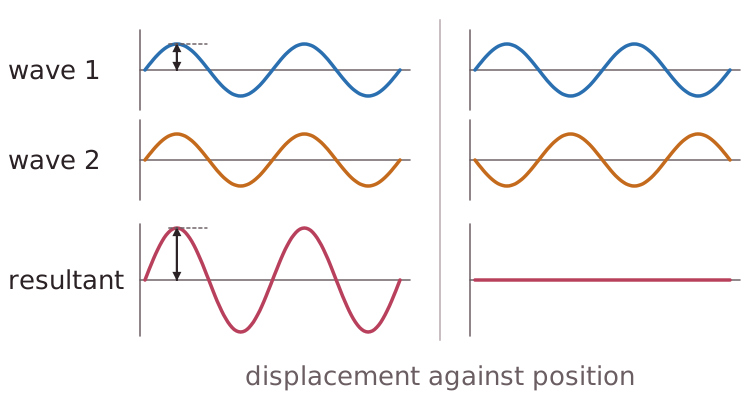
When two waves of the same type meet, they pass through each other. When the waves overlap or superpose they produce a single wave whose displacement at each point is the vector sum of the displacement of the individual waves. This effect is called interference. Constructive interference occurs when the two waves are in phase. The amplitude of the new wave is the sum of the amplitudes of the individual waves. Destructive interference occurs when the two waves are in antiphase. If the waves have the same amplitude they will cancel each other out completely, and the resulting wave will have zero amplitude and the intensity is zero. The reduction in displacement means that light is dimmer and sound is quieter.