A ductile material can be drawn into wires. A malleable material can be hammered into sheets. Copper and steel are ductile.A strong material is one with a high ultimate tensile strength. This is the maximum stress a material can withstand when being stretched before breaking. Beyond this point, necking may occur.The stress value at the point of fracture is called the breaking strength of the material.Polymers like rubber and polythene can stretch a great deal before breaking. Rubber has a low ultimate tensile strength.A brittle material shows elastic behaviour up to its breaking point and breaks with little or no plastic deformation. Ceramics are brittle.
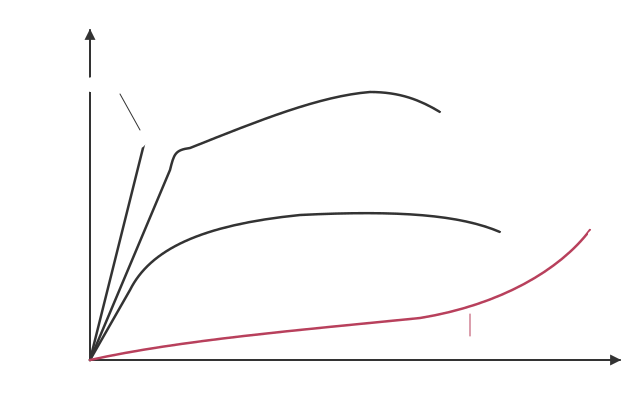
More Stress-Strain Graphs
Read the text
Read the text and highlight anything you think is important. When you go on, the text is hidden and you answer from memory.
Specification: OCR Physics A (H156), AS-level, 3.4.2 Mechanical properties of matter. Topic: Materials.
Key terms in this lesson
- principle of conservation of momentum
- For a system of interacting objects, the total momentum in a given direction remains constant provided no external forces act on the system.
- closed system
- A system of interacting objects on which no external forces act.
More in Materials
- Metal Wire Deformation
- Rubber
- Polythene
- Tensile Stress
- Tensile Strain
- Stress-Strain Graph
- The Young Modulus
- Measuring the Young Modulus
All 14 lessons in Materials · All OCR AS-level Physics topics