 BRAINCAKE
Drag and Terminal Velocity
An object moving through a fluid (e.g. air or water) experiences a resistive drag force from the fluid. Drag is a frictional force that opposes the motion of the object through the fluid. Drag is influenced by the shape and the speed of the object. Drag increases with speed and is proportional to the square of the speed.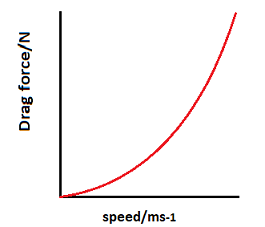
When an object falls through a fluid, initially there is only the weight acting on the object and the acceleration is g
Sign in free to see the rest of this lesson, the R.E.C.I.P.E. recall steps and the quiz
BrainCake is free. Make an account in seconds and pick up where this page stops.
Key terms in this lesson
- resultant
- The single force or vector that has the same effect as two or more forces or vectors acting together.
- velocity
- The rate of change of displacement of an object; speed in a given direction.
- acceleration
- The rate of change of velocity of an object.
- weight
- The gravitational force acting on an object's mass.
More in Forces and Motion
- Car Stopping Distances
- Weight, Mass, Accleration
- Centre of Mass
- Free-Body Force Diagrams
- Moments and Equilibrium
- Couples and Torques
- Forces in Equilibrium
- Density and Pressure
All 17 lessons in Forces and Motion · All OCR AS-level Physics topics