A couple is a pair of equal and opposite forces that are parallel but act along different lines.
The moment of a couple is known as a torque.
The torque of a couple = one of the forces × perpendicular separation between the forces.
Torque = F d
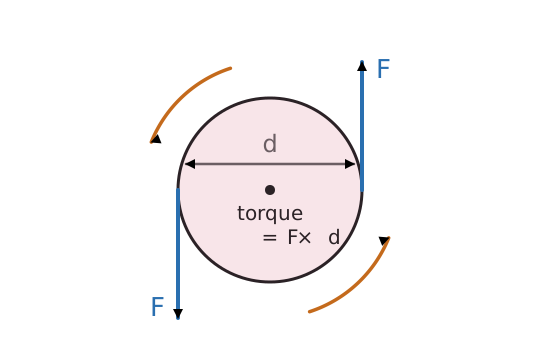 For a pair of forces to form a couple, they must be equal in size, opposite in direction and act along parallel lines that are a distance apart. Because the two forces are equal and opposite, the resultant force is zero, so a couple causes rotation only. It does not make the object accelerate in a straight line.The distance d is the perpendicular separation between the lines of action of the two forces. Torque is measured in newton metres (N m).
torque = F × d For example, a driver pushes up on one side of a steering wheel of diameter 0.40 m and pulls down on the other side, each with a force of 15 N. The torque of the couple is 15 × 0.40 = 6.0 N m.The torque of a couple has the same value about any point, so it does not matter where the axis of rotation is. Other examples of couples are turning a tap, a wheel brace or a bottle top with the finger and thumb.
The moment of a couple is known as a torque.
The torque of a couple = one of the forces × perpendicular separation between the forces.
Torque = F d
For a pair of forces to form a couple, they must be equal in size, opposite in direction and act along parallel lines that are a distance apart. Because the two forces are equal and opposite, the resultant force is zero, so a couple causes rotation only. It does not make the object accelerate in a straight line.The distance d is the perpendicular separation between the lines of action of the two forces. Torque is measured in newton metres (N m).