QuestionA student measures the maximum kinetic energy Ek(max) of photoelectrons emitted from a metal for light of several different frequencies f, and plots a graph of Ek(max) against f. The result is a straight line that crosses the frequency axis at 5.0 × 10¹⁴ Hz.(a) Use the photoelectric equation to explain why the graph is a straight line. (2)
(b) State what the gradient of the line represents. (1)
(c) Calculate the work function of the metal. (2)
(d) The experiment is repeated with a metal of larger work function. Describe how the new line compares with the first. (2)Answer(a) Rearranging hf = φ + Ek(max) gives:Ek(max) = hf − φ
This has the form y = mx + c, with h and φ both constant, so Ek(max) against f is a straight line. (2)(b) The gradient is the Planck constant, h. (1)(c) The intercept on the frequency axis is the threshold frequency, f0 = 5.0 × 10¹⁴ Hz, where Ek(max) = 0. (1)φ = hf0 = 6.63 × 10-34 × 5.0 × 1014 = 3.3 × 10⁻¹⁹ J
(1)(d) The new line is parallel to the first, because the gradient is still h. (1) It is shifted to the right, crossing the frequency axis at a higher threshold frequency. (1)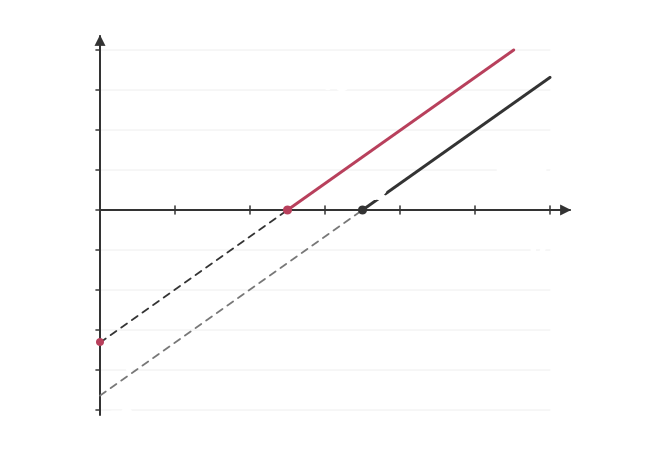
- The line does not pass through the origin.
(b) State what the gradient of the line represents. (1)
(c) Calculate the work function of the metal. (2)
(d) The experiment is repeated with a metal of larger work function. Describe how the new line compares with the first. (2)Answer(a) Rearranging hf = φ + Ek(max) gives:
This has the form y = mx + c, with h and φ both constant, so Ek(max) against f is a straight line. (2)(b) The gradient is the Planck constant, h. (1)(c) The intercept on the frequency axis is the threshold frequency, f0 = 5.0 × 10¹⁴ Hz, where Ek(max) = 0. (1)
(1)(d) The new line is parallel to the first, because the gradient is still h. (1) It is shifted to the right, crossing the frequency axis at a higher threshold frequency. (1)
- The line does not pass through the origin.