Skip to content

The Parallelogram Rule

The resultant of two vectors is the diagonal of a parallelogram formed where the sides of the parallelogram are composed from the two vectors.
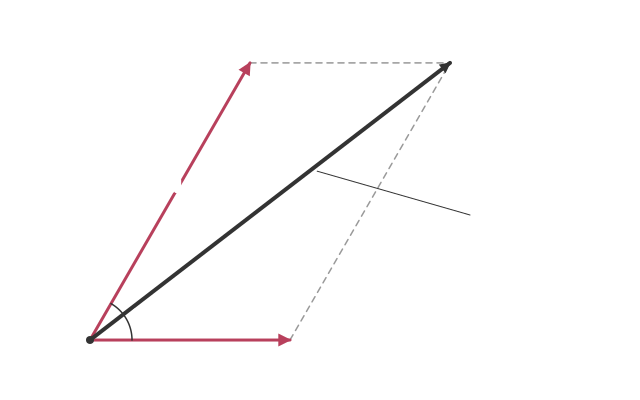
To use the rule, draw both vectors from the same point (tail to tail), to scale and at the correct angle. Complete the parallelogram by drawing a line parallel to each vector from the tip of the other. The resultant is the diagonal drawn from the common starting point.This gives the same answer as drawing the vectors tip to tail, because opposite sides of a parallelogram are equal and parallel.Scale drawing: choose a scale such as 1 cm = 1 N, then measure the length of the diagonal with a ruler and its angle with a protractor.Calculation: for two forces F1 and F2 with an angle θ between them, the cosine rule gives
R2 = F12 + F22 + 2F1F2cosθ
Worked example: forces of 5.0 N and 8.0 N act from the same point with 60° between them.
R2 = 25 + 64 + (2 × 5.0 × 8.0 × 0.50) = 129
R = 11.4 N
Check the limits: when θ = 0° the forces simply add to give 13 N, and when θ = 180° the resultant is 8.0 - 5.0 = 3.0 N. When θ = 90°, cosθ = 0 and the rule reduces to Pythagoras.

Read the text

Read the text and highlight anything you think is important. When you go on, the text is hidden and you answer from memory.