Skip to content

Adding Forces

Forces are vectors and we can use vector addition.In one dimension we can use + and - to show opposite directions.
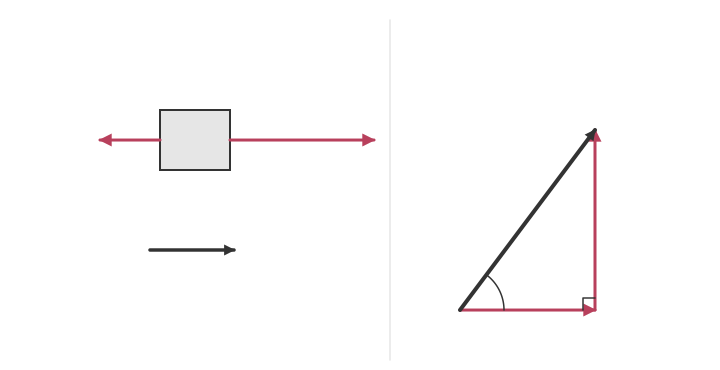
The resultant force is the single force that has the same effect as all the forces acting together.Forces along a line: choose one direction as positive and add the forces with their signs. A 12 N force to the right and a 5 N force to the left give a resultant of 12 + (-5) = 7 N to the right.Forces at an angle: draw the vectors tip to tail. The resultant is the arrow drawn from the tail of the first vector to the tip of the last one. The order in which the vectors are drawn does not change the resultant.When two forces are at right angles, the vector triangle is right-angled, so use Pythagoras for the size and trigonometry for the direction.Worked example: a 3.0 N force acts east and a 4.0 N force acts north on the same object.
F = √(3.02 + 4.02) = 5.0 N
θ = tan-1(4.0 ÷ 3.0) = 53° north of east
To subtract a vector, add its negative: reverse its arrow, then draw tip to tail. For example, the change in velocity is Δv = v + (-u).

Read the text

Read the text and highlight anything you think is important. When you go on, the text is hidden and you answer from memory.