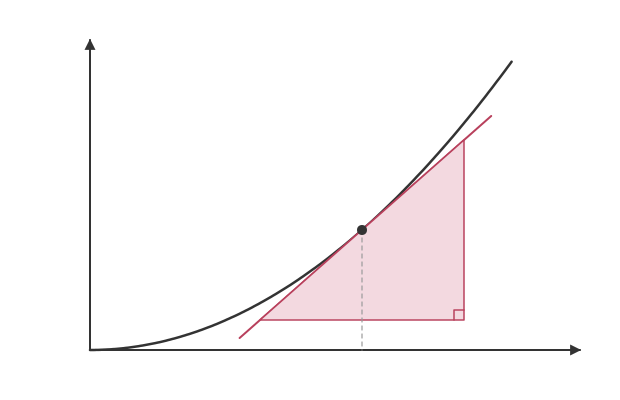
Average speed = total distance ÷ total time takeninstantaneous speed is the speed at a particular time and is the gradient of the tangent of a distance-time graph at a particular time t.average speed = total distance ÷ total time Average speed ignores any changes in speed during a journey. A train that covers 180 km in 2.0 hours has an average speed of 90 km h-1, even though it stopped at stations and at times travelled faster than this.Worked example: a cyclist rides 1200 m in 150 s, rests for 50 s, then rides 800 m in 100 s.average speed = (1200 + 800) ÷ (150 + 50 + 100) = 2000 ÷ 300 = 6.7 m s-1 The rest time counts, because it is part of the total time.Instantaneous speed is what a speedometer shows. On a curved distance-time graph, draw a tangent to the curve at time t, make a large triangle on it, and divide its rise (distance) by its run (time). The steeper the tangent, the greater the instantaneous speed.