Skip to content

Investigating Terminal Velocity

Drop steel ball in viscous fluid and measure terminal velocity by timing how long the ball takes to move a fixed distance and recording the velocity when it does not change.
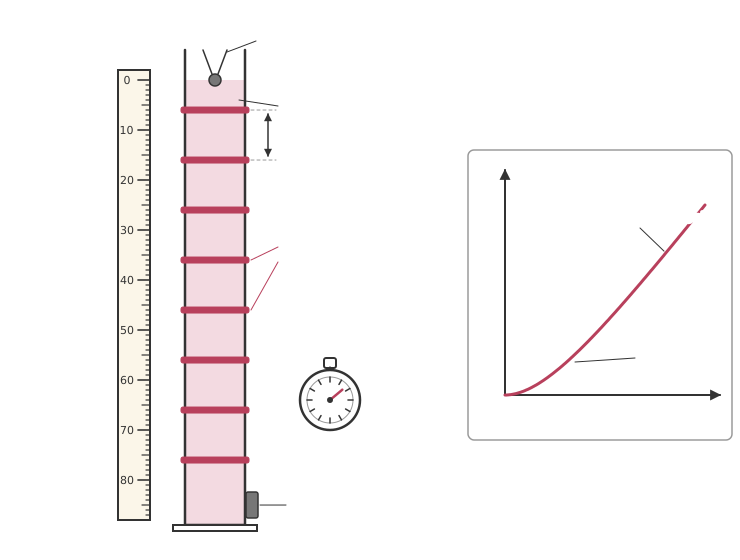
A tall measuring cylinder is filled with a viscous liquid such as glycerol. Marks, for example rubber bands, are placed at equal intervals (say every 10.0 cm) down the cylinder, starting a little below the surface.A small steel ball bearing is released just at the surface. The time to pass between each pair of marks is recorded with a stopwatch, or more precisely by filming the fall beside a metre rule and stepping through the video frame by frame.While the ball is still accelerating, the times for equal distances get shorter. Once the times for successive intervals are the same, the ball has reached terminal velocity:
terminal velocity = distance between marks ÷ time
Worked exampleMarks are 10.0 cm apart. The times for successive intervals are 0.62 s, 0.55 s, 0.52 s, 0.52 s and 0.52 s. The time has stopped changing, so the terminal velocity is 0.100 m ÷ 0.52 s = 0.19 m s-1.A distance-time graph can also be plotted. It curves at first and then becomes a straight line, whose gradient is the terminal velocity.Repeat several times and take a mean. Keep the liquid at a constant temperature, because viscosity changes with temperature, and recover the ball bearings with a magnet held against the outside of the cylinder.

Read the text

Read the text and highlight anything you think is important. When you go on, the text is hidden and you answer from memory.