Skip to content

Investigating Flow Rates

The rate of flow of a fluid through a pipe is inversely proportional to the viscosity of the fluid.Rate of flow is the volume of fluid passing a point per unit time:
rate of flow = volume ÷ time
It is measured in m3 s-1, or cm3 s-1 in the laboratory.A simple investigation compares liquids of different viscosity. Clamp a burette vertically and fill it to the 0 cm3 mark. Open the tap fully and time how long the level takes to fall from the 0 cm3 mark to the 50 cm3 mark. Repeat three times and take a mean.
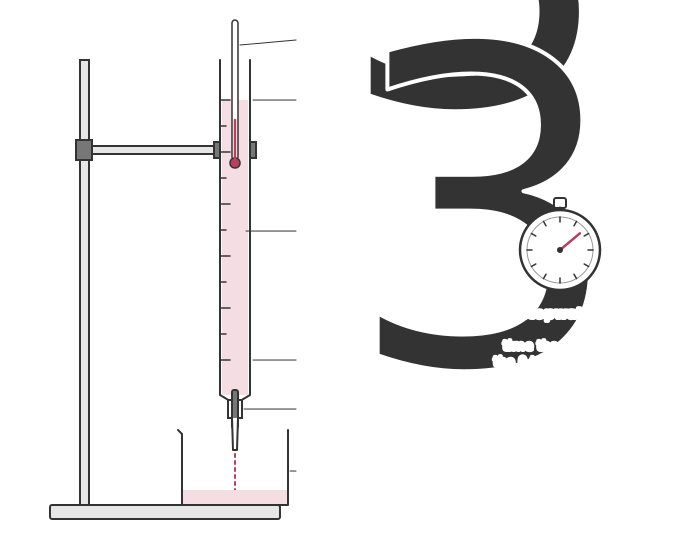
Repeat with other liquids such as water, cooking oil and glycerol. For a fair test use the same burette, open the tap by the same amount and keep every liquid at the same temperature, because viscosity depends on temperature. As the burette empties the height of liquid falls, which lowers the flow rate, so the same start and end marks must be used for every liquid.Worked example50 cm3 of water drains in 20 s, so its rate of flow is 50 ÷ 20 = 2.5 cm3 s-1.Under the same conditions, a second liquid has twice the viscosity of water. Rate of flow is inversely proportional to viscosity, so its rate of flow is 2.5 ÷ 2 = 1.25 cm3 s-1, and the 50 cm3 takes 40 s to drain.The rate of flow also depends on the pressure difference along the pipe and, very strongly, on the radius of the pipe.

Read the text

Read the text and highlight anything you think is important. When you go on, the text is hidden and you answer from memory.

Specification: Edexcel Physics (8PH0), AS-level, Topic 4: Materials. Topic: Fluids.

Key terms in this lesson

viscosity
A measure of a fluid's resistance to flow, arising from internal friction between its layers.

More in Fluids

All 15 lessons in Fluids · All Edexcel AS-level Physics topics