A machine that moves an object does work on the object by applying a force on the object and moving it in the direction of the force.Work done W = F swhere F is the applied force and s is the distance moved in the direction of the force.
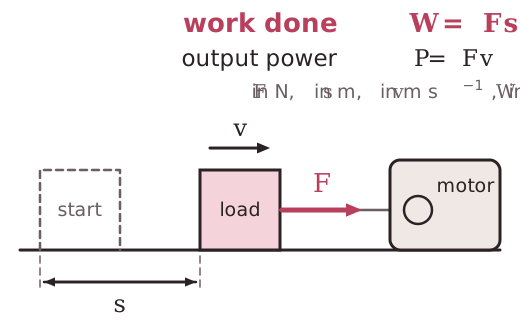
The output power of the machine P = F v
Machines and Work
Read the text
Read the text and highlight anything you think is important. When you go on, the text is hidden and you answer from memory.
Specification: AQA Physics (7407), AS-level, 3.4.1.7 Work, energy and power. Topic: Work, Energy and Power.
Key terms in this lesson
- Spring constant
- The force per unit extension needed to stretch a spring, equal to the gradient of a force-extension graph while Hooke's law is obeyed.
- Tensile stress
- The force applied to a material divided by its cross-sectional area.
- Ultimate tensile stress
- The maximum stress a material can withstand before it begins to fail; also called the breaking stress.
- Plastic deformation
- Deformation of a material beyond its elastic limit, so that it does not return to its original shape or length when the load is removed.
More in Work, Energy and Power
- Muscle Power
- Electrical Power
- Engine Power
- Drag Force
- Electric Motor
- Pulley System
- Efficiency
- Improving Efficiency
All 21 lessons in Work, Energy and Power · All AQA AS-level Physics topics