When a machine transfers energy, only some of the energy supplied is transferred for the intended purpose. This is the useful energy. The rest is wasted, usually as heat and sound caused by friction and electrical resistance.The efficiency of a machine is the fraction of the energy supplied that is transferred usefully: efficiency = useful energy output ÷ total energy input.Since power is energy transferred per second, efficiency can also be calculated from powers: efficiency = useful output power ÷ input power. Multiply by 100 to express it as a percentage.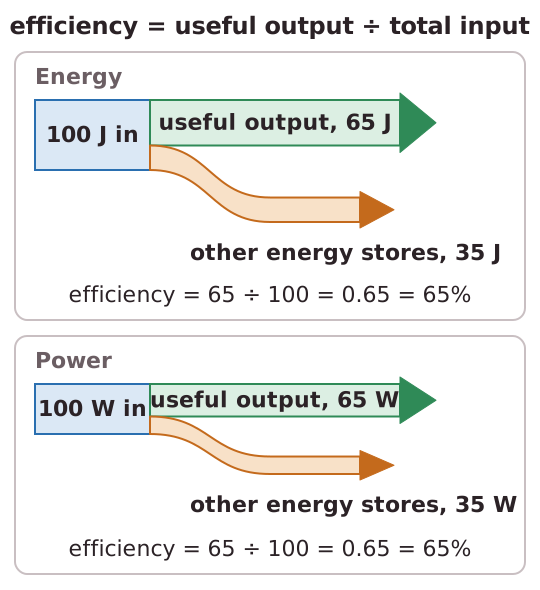 No real machine can be 100% efficient, because some energy is always dissipated to the surroundings. The efficiency is always less than 1.For example, a motor that takes 1000 W of electrical power and delivers 800 W of useful mechanical power has an efficiency of 800 ÷ 1000 = 0.80, or 80%. The other 200 W is wasted, mostly as heat in the coils and friction in the bearings.