Light is composed of photons (wave packets)
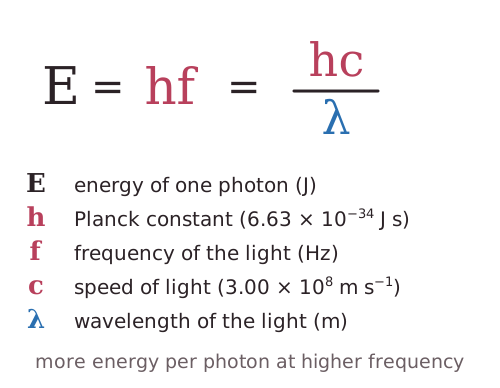
h = Planck constant 6.63 × 10⁻³⁴ JsOne electron at the surface of the metal absorbs a single photon.The electron gains energy E = hf.If hf > φ (work function= minimum energy needed for photoemission) then an electron is emitted.
Explanation of the Photoelectric Effect
Read the text
Read the text and highlight anything you think is important. When you go on, the text is hidden and you answer from memory.
Specification: AQA Physics (7407), AS-level, 3.2.2.1 The photoelectric effect. Topic: The Photoelectric Effect.
Key terms in this lesson
- Equilibrium
- An object is in equilibrium when the resultant force and the resultant moment acting on it are both zero.
More in The Photoelectric Effect
- The Photoelectric Effect
- The Stopping Potential
- Planck's Quantum Theory
- The Vacuum Photocell
- Ionisation
- Measuring Ionisation Energy
- Energy of Electrons
- Electron Excitation by Collisions
All 19 lessons in The Photoelectric Effect · All AQA AS-level Physics topics