 BRAINCAKE
Uncertainty in a Gradient
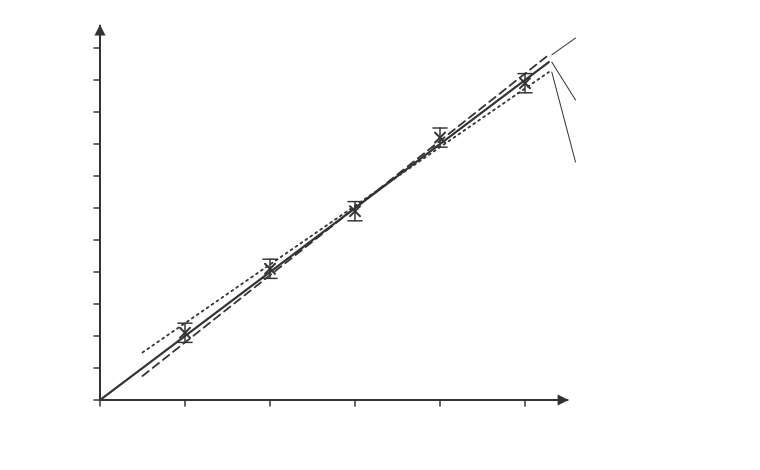
When a gradient (or intercept) gives a physical quantity, you need its uncertainty. Once error bars are drawn, two lines are used:
• the line of best fit, passing through all the error bars with points evenly scattered either side;
• the worst acceptable line: the steepest or the shallowest straight line that still passes through all the error bars. It usually joins the bottom of the first error bar to the top of the last (steepest), or the top of the first to the bottom of the last (shallowest).
Sign in free to see the rest of this lesson, the R.E.C.I.P.E. recall steps and the quiz
BrainCake is free. Make an account in seconds and pick up where this page stops.
More in Measurements and Errors
- Converting Units
- Random and Systematic Errors
- Precision, Repeatability and Reproducibility
- Resolution and Accuracy
- Absolute, Fractional and Percentage Uncertainty
- Combining Uncertainties
- Uncertainties on Graphs
- Estimation and Orders of Magnitude
All 12 lessons in Measurements and Errors · All AQA AS-level Physics topics