Precision describes how close repeated measurements of the same quantity are to each other. Precise measurements are consistent: they fluctuate only slightly about a mean value, so they show little spread. Precision is affected by random errors, not by systematic errors, so a set of readings can be precise and still be wrong.Repeatability: a measurement is repeatable if the original experimenter repeats the investigation using the same method and the same equipment and obtains the same results.Reproducibility: a measurement is reproducible if the investigation is repeated by another person, or by using different equipment or techniques, and the same results are obtained.Repeatability checks that your own method gives consistent results. Reproducibility is a stronger test: it shows that the result does not depend on one particular person, instrument or technique. This is why scientists publish their methods, so that others can try to reproduce their results.Example: A student times 10 oscillations of a pendulum five times and records 14.2 s, 14.3 s, 14.2 s, 14.1 s and 14.2 s. The spread is small (the range is 14.3 − 14.1 = 0.2 s), so the readings are precise and the measurement is repeatable. A second student, using a light gate and data logger instead of a stopwatch, also finds 14.2 s, so the result is reproducible too.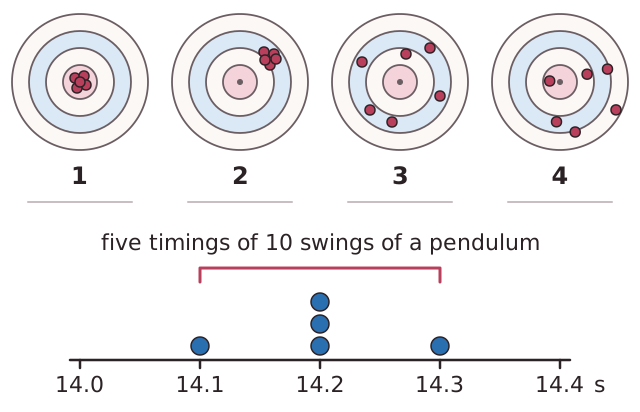 Precision says nothing about how close the readings are to the true value. Readings that all share a large zero error can be very precise but not accurate; accuracy is covered in the next lesson.