The potential difference rules come from the conservation of energy. The energy given to each coulomb of charge by the source must equal the energy it transfers to the components as it goes around the circuit.For any complete loop of a circuit, the sum of the emfs equals the sum of the potential differences around the loop. For a single cell connected to two components in series, ε = V1 + V2.
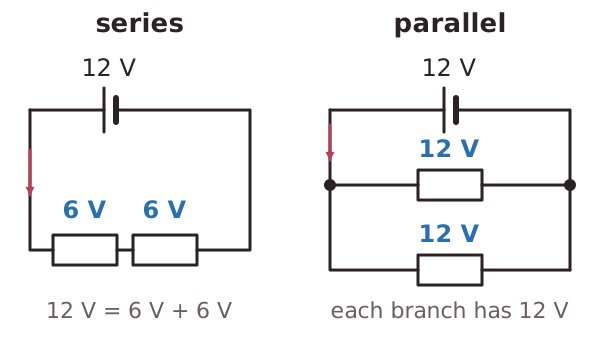
Components connected in parallel have the same potential difference across them, because each coulomb of charge passes through only one branch and transfers the same energy whichever branch it takes.For example, two identical lamps in series with a 12 V battery each have a p.d. of 6 V across them. If a single lamp is connected directly across the same battery, it has the full 12 V across it.
Potential Difference Rules
Read the text
Read the text and highlight anything you think is important. When you go on, the text is hidden and you answer from memory.
Specification: AQA Physics (7407), AS-level, 3.5.1.5 Potential divider and 3.5.1.4 Circuits. Topic: Direct Current Circuits.
More in Direct Current Circuits
- Current Rules
- Resistors in Series
- Resistors in Parallel
- Resistance Heating
- Internal Resistance
- Power
- Measuring Internal Resistance
- Cells in Series
All 15 lessons in Direct Current Circuits · All AQA AS-level Physics topics