 BRAINCAKE
Measuring Internal Resistance
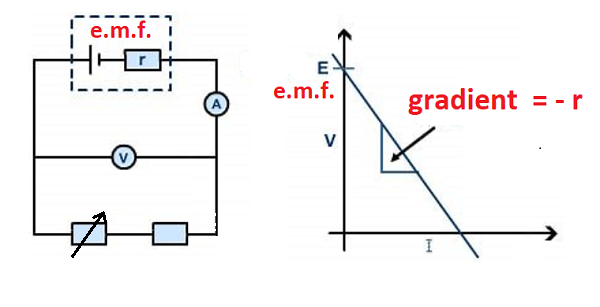
The p.d. across the terminals of a cell can be measured using a high resistance voltmeter when the cell is in a circuit and current is flowing.
The current is varied by adjusting a variable resistor and a fixed resistor is used to limit the maximum current that can pass through the cell
Sign in free to see the rest of this lesson, the R.E.C.I.P.E. recall steps and the quiz
BrainCake is free. Make an account in seconds and pick up where this page stops.
Key terms in this lesson
- Electromotive force
- The electrical energy produced per unit charge by a source, such as a cell, in driving current around a circuit.
- Potential difference
- The energy transferred per unit charge as charge moves between two points in a circuit.
- Resistance
- The ratio of the potential difference across a component to the current flowing through it, measured in ohms.
More in Direct Current Circuits
- Resistors in Parallel
- Resistance Heating
- Internal Resistance
- Power
- Cells in Series
- Cells In Parallel
- Diodes in Circuits
- The Potential Divider - Fixed p.d.
All 15 lessons in Direct Current Circuits · All AQA AS-level Physics topics