Alpha particles consist of two neutrons and two protons (i.e. a helium nucleus) and are positively charged. The range of alpha particles is different from one source to another, but alpha particles from the same source all have the same range and kinetic energy.
Beta particles were proven to be electrons by measuring their deflection in electric and magnetic fields. A nucleus with too many neutrons emits an electron. A nucleus with too many protons emits a positron (anti-electron). β particles have a range of kinetic energies up to a maximum. Beta particles can be stopped by 5mm of aluminium.
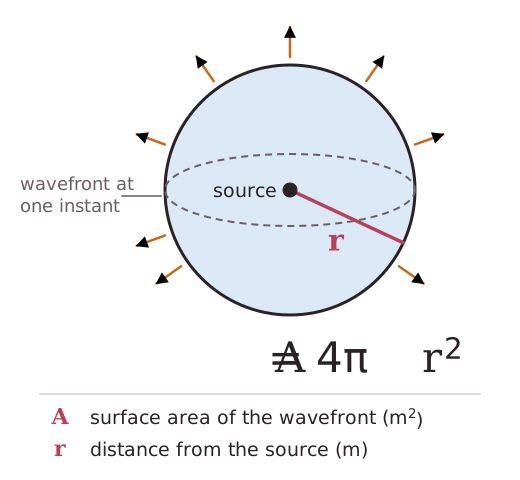
Gamma radiation is electromagnetic radiation which spreads out from the source in all directions and is diffracted in the same way light is diffracted.