 BRAINCAKE
Geiger Tube
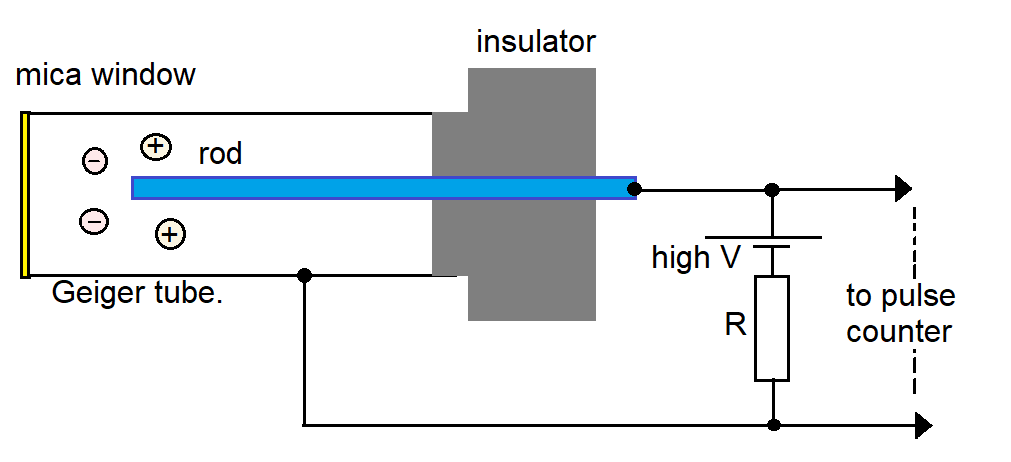
A Geiger tube is a sealed metal tube that contains argon gas at low pressure. Alpha and beta particles and gamma radiation enter the tube through a thin mica window. The tube wall is connected to the negative potential and there is a metal rod in the tube which is connected to the positive terminal. As ionising radiation passes through the tube ions are created and discharged at the electrodes. The ions create more ions so in a short time many ions are created. A voltage pulse across the circuit is recorded as a single count.
Sign in free to see the rest of this lesson, the R.E.C.I.P.E. recall steps and the quiz
BrainCake is free. Make an account in seconds and pick up where this page stops.
Key terms in this lesson
- beta radiation
- Ionising radiation consisting of high-speed electrons, or positrons, emitted from an unstable nucleus.
- gamma radiation
- Ionising electromagnetic radiation emitted from the nucleus of an unstable atom, usually following alpha or beta emission.
- background radiation
- Ionising radiation that is present in the environment at all times, from sources such as rocks, cosmic rays and man-made sources.
More in Radioactivity
- Rutherford's α-Particle Scattering Experiment.
- Rutherford's Interpretation
- Radioactivity
- Radioactivity Observations
- The nature of α, β and γ Radiation.
- Gamma radiation
- Radioactive Change
- The Dangers of Radioactivity
All 25 lessons in Radioactivity · All OCR A-level Physics topics