Many radioactive decays results in the formation of isotopes which are themselves radioactive and decay further. When a radioactive isotope decays its daughter nucleus may itself be unstable and decays into an α or β- or β+ particle depending on where it is relative to the stability belt. The series of decays can be represented on a decay graph.In nature, the presence of radioactive isotopes is due to isotopes in the decay chains having long half-lives.
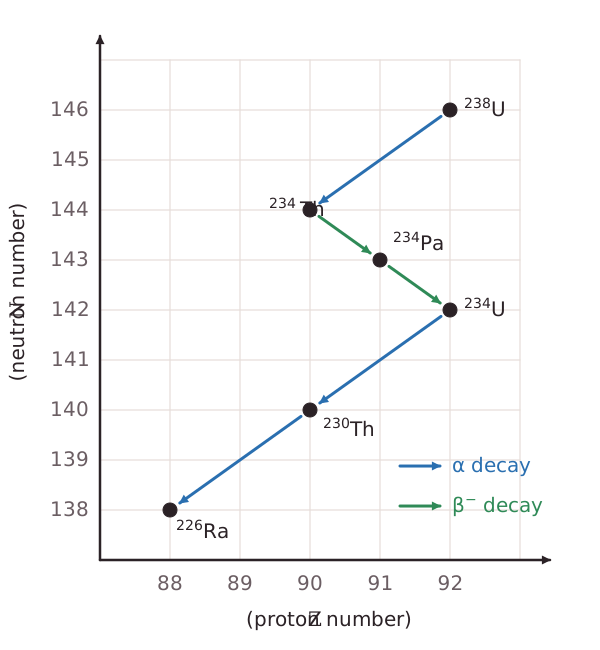
Decay Series
Read the text
Read the text and highlight anything you think is important. When you go on, the text is hidden and you answer from memory.
Specification: OCR Physics A (H556), A-level, 6.4.3 Radioactivity. Topic: Radioactivity.
Key terms in this lesson
- hubble's law
- The recession speed of a galaxy is directly proportional to its distance from us.
- dark energy
- An unknown form of energy, spread evenly through space, thought to be responsible for the accelerating expansion of the universe.
More in Radioactivity
- Radioactive Tracers
- Thickness monitoring and Engine Wear
- Power Sources
- N-Z Graph
- Energy Levels
- Technetium
- Electron Diffraction
- Nuclear Radius and Density
All 25 lessons in Radioactivity · All OCR A-level Physics topics