 BRAINCAKE
Argon Dating
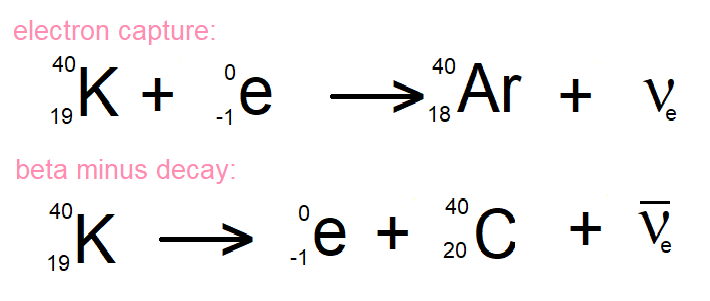
Potassium-40 in rocks undergoes electron capture and changes to argon-40 and a neutrino. The argon-40 is trapped in the rocks. Potassium-40 also decays by beta emission to form Calcium-40. The probability of potassium decaying to calcium is 8x greater than the probability of electron capture so the half-life of electron capture is effectively 1250 million years. The age of the rock can then be calculated by measuring the proportion of argon-40 to potassium-40 in the rock.
Sign in free to see the rest of this lesson, the R.E.C.I.P.E. recall steps and the quiz
BrainCake is free. Make an account in seconds and pick up where this page stops.
Key terms in this lesson
- half-life
- The average time taken for the number of nuclei of a radioactive isotope in a sample, or its activity, to halve.
More in Radioactivity
- Activity
- Radioactive Decay
- Decay Constant
- Radiocarbon dating
- Radioactive Tracers
- Thickness monitoring and Engine Wear
- Power Sources
- N-Z Graph
All 25 lessons in Radioactivity · All OCR A-level Physics topics