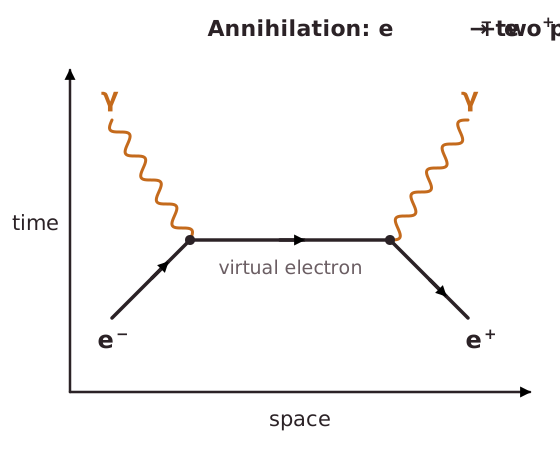
In radioactive decay, energy is released. The total mass of all the decay products after the decay is less than the total mass of the nucleus before the decay as some of the mass has been converted to the energy released. The relationship between the energy released Q and the difference in mass Δm is that Q = Δmc2 where c is the speed of light in a vacuum.One atomic mass unit = 1.661 x 10⁻²⁷kg = 931.5 MeV. In alpha decay the energy is shared between the recoiling nucleus and the emitted alpha-particle. In beta-decay the energy is shared between the nucleus, the beta-particle, neutrino or anti-neutrino. In electron capture, the energy is transferred to the kinetic energy of the neutrino and an X-ray photon that is emitted.
Mass-Energy Equivalence
Read the text
Read the text and highlight anything you think is important. When you go on, the text is hidden and you answer from memory.
Specification: OCR Physics A (H556), A-level, 6.4.4 Nuclear fission and fusion. Topic: Nuclear Energy.
Key terms in this lesson
- antiparticle
- A particle with the same mass as its corresponding particle but the opposite charge or other quantum numbers.
- neutrino
- A fundamental, uncharged lepton with a very small mass that interacts only through the weak force and gravity.
More in Nuclear Energy
- Strong Nuclear Force
- Binding Energy and Nuclear Stability
- Quantum Tunnelling
- Nuclear Fission
- Nuclear Fusion
- Nuclear Reactors
- Safety
All 8 lessons in Nuclear Energy · All OCR A-level Physics topics