Clusters of neutrons and protons can form in a very large nucleus. If a cluster of 2 neutrons and 2 protons forms the binding energy is large compared to other clusters and the alpha particle formed gains kinetic energy equal to the binding energy. This energy is not sufficient to leave the nucleus.However, if you consider the wave properties of matter, the alpha particles position can be calculated from the probability that the alpha particle is in any one place. There is therefore a small, non-zero probability that the alpha-particle can be positioned outside the nucleus i.e. it can tunnel through the potential energy barrier without gaining any extra energy.
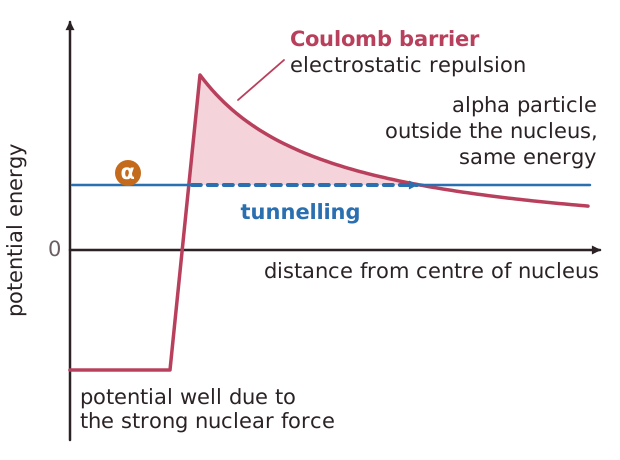
Quantum Tunnelling
Read the text
Read the text and highlight anything you think is important. When you go on, the text is hidden and you answer from memory.
Specification: OCR Physics A (H556), A-level, 6.4.4 Nuclear fission and fusion. Topic: Nuclear Energy.
Key terms in this lesson
- hadron
- A particle made of quarks that is affected by the strong nuclear force, such as a proton or neutron.
- quark
- A fundamental particle that combines with others, bound by the strong nuclear force, to form hadrons such as protons and neutrons.
- lepton
- A fundamental particle, such as the electron or neutrino, that does not feel the strong nuclear force.
More in Nuclear Energy
- Mass-Energy Equivalence
- Strong Nuclear Force
- Binding Energy and Nuclear Stability
- Nuclear Fission
- Nuclear Fusion
- Nuclear Reactors
- Safety
All 8 lessons in Nuclear Energy · All OCR A-level Physics topics