An ultrasound transducer uses a piezoelectric crystal to both transmit ultrasound and receive the echoes.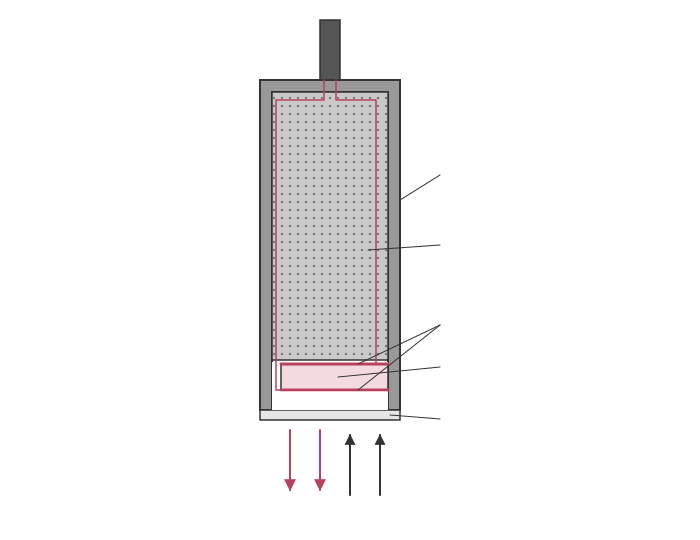
• Backing material behind the crystal (such as epoxy resin loaded with tungsten powder). It damps the vibrations so the crystal stops quickly, giving short pulses, and absorbs ultrasound sent backwards
• Front layer (acoustic window) that protects the crystal and helps pass ultrasound into the body
• Casing that insulates and holds the partsShort pulses give better resolution, because echoes from two boundaries close together do not overlap.The transducer works in pulse-echo mode: it sends a short pulse, then acts as a receiver while the echoes return, then sends the next pulse. Only a small fraction of the time is spent transmitting.The crystal vibrates most strongly at resonance, when its thickness is half the wavelength of ultrasound in the crystal.Worked example: the speed of ultrasound in a PZT crystal is 4000 m s−1. Find the thickness needed for a 2.0 MHz transducer.λ = c / f = 4000 / 2.0 × 106 = 2.0 × 10⁻³ m = 2.0 mm
thickness = λ / 2 = 1.0 mm A higher-frequency transducer needs a thinner crystal.
• Backing material behind the crystal (such as epoxy resin loaded with tungsten powder). It damps the vibrations so the crystal stops quickly, giving short pulses, and absorbs ultrasound sent backwards
• Front layer (acoustic window) that protects the crystal and helps pass ultrasound into the body
• Casing that insulates and holds the partsShort pulses give better resolution, because echoes from two boundaries close together do not overlap.The transducer works in pulse-echo mode: it sends a short pulse, then acts as a receiver while the echoes return, then sends the next pulse. Only a small fraction of the time is spent transmitting.The crystal vibrates most strongly at resonance, when its thickness is half the wavelength of ultrasound in the crystal.Worked example: the speed of ultrasound in a PZT crystal is 4000 m s−1. Find the thickness needed for a 2.0 MHz transducer.