 BRAINCAKE
The Strong Nuclear Force
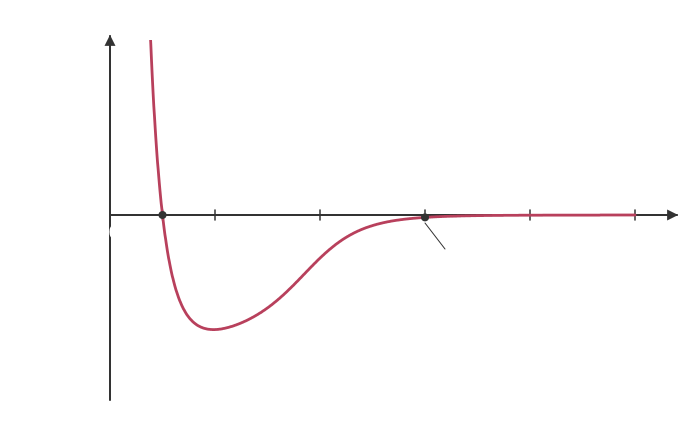
The nucleus contains positively charged protons, which repel each other electrostatically. The gravitational attraction between nucleons is far too weak to hold the nucleus together. Instead, a much stronger force acts: the strong nuclear force.
Properties of the strong nuclear force:
• It acts between all hadrons (such as protons and neutrons) and between the quarks inside them. It does not act on leptons such as electrons.
• It acts equally between proton-proton, proton-neutron and neutron-neutron pairs.
• It has a very short range. It is attractive up to a separation of about 3 fm (3 × 10⁻¹⁵ m), and beyond that it quickly becomes negligible.
Sign in free to see the rest of this lesson, the R.E.C.I.P.E. recall steps and the quiz
BrainCake is free. Make an account in seconds and pick up where this page stops.
Key terms in this lesson
- hadron
- A particle made of quarks that is affected by the strong nuclear force, such as a proton or neutron.
- quark
- A fundamental particle that combines with others, bound by the strong nuclear force, to form hadrons such as protons and neutrons.
- lepton
- A fundamental particle, such as the electron or neutrino, that does not feel the strong nuclear force.
More in Fundamental Particles
- Fundamental Particles
- Antiparticles
- Hadrons and Leptons
- Quarks and Antiquarks
- Quark Composition of Protons and Neutrons
- Baryons and Mesons
- Beta-Minus Decay and Quarks
- Beta-Plus Decay and Quarks
All 11 lessons in Fundamental Particles · All OCR A-level Physics topics