When the charge on capacitor C decreases by ΔQ through fixed resistor R in time Δt, I = V/R where V = Q/C. This means that I = Q/RC and ΔQ the change in charge becomes -QΔt/CR.The curves all have the same shape as the current is proportional to the charge and the charge is proportional to the potential difference.
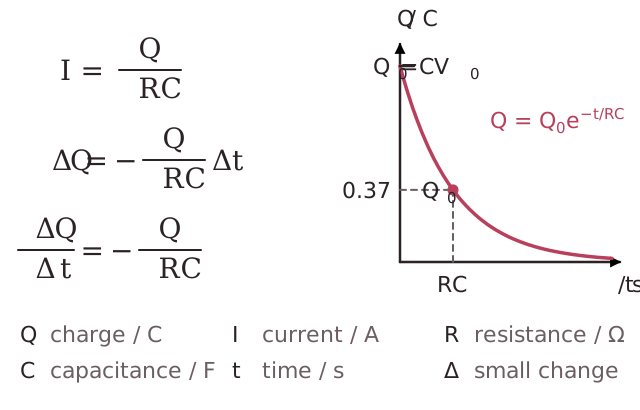
Exponential Decay.
Read the text
Read the text and highlight anything you think is important. When you go on, the text is hidden and you answer from memory.
Specification: OCR Physics A (H556), A-level, 6.1.3 Charging and discharging capacitors. Topic: Capacitors.
Key terms in this lesson
- magnetic field
- A region of space in which a moving charge, current-carrying conductor or magnetic material experiences a force.
- motor effect
- The force produced on a current-carrying conductor placed in an external magnetic field.
- Lenz's law
- The direction of an induced current is always such as to oppose the change that caused it.
- magnetic flux
- The product of the magnetic flux density and the area through which the field lines pass at right angles.
- magnetic flux linkage
- The product of the magnetic flux through a coil and the number of turns on the coil.
More in Capacitors
- Use of Capacitors
- Energy Stored in a Charged Capacitor
- Measuring the Energy Stored in a Charged Capacitor.
- Energy stored in a Thundercloud
- Discharging a Capacitor through a Fixed Resistor
- The Time Constant RC
- Measurement with Oscilloscope. Capacitor Smoothing
- Charging a Capacitor through a fixed resistor
All 12 lessons in Capacitors · All OCR A-level Physics topics