Dark matter is matter that does not emit or absorb electromagnetic radiation, so it cannot be seen directly. We know it is there only because of its gravitational effects on visible matter.The main evidence comes from the rotation curves of spiral galaxies. A rotation curve is a graph of the orbital speed of stars against their distance from the centre of the galaxy.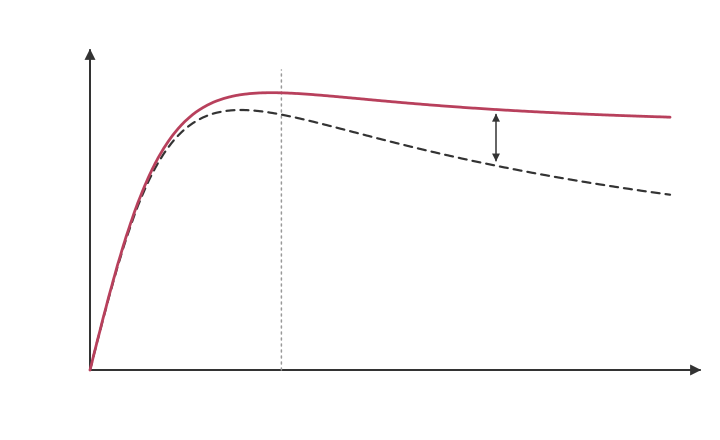
v = √(GM/r) The orbital speed of the outer stars should therefore fall as r increases. Instead, measurements (from the Doppler shift of their light) show that the speed stays roughly constant far out from the centre: the curve is flat.So there must be much more mass than we can see, spread out well beyond the visible disc. Astronomers suggest that each galaxy is surrounded by a huge halo of dark matter. Further evidence comes from galaxies in clusters, which move too fast to be held together by their visible mass alone.What dark matter is remains unknown. Suggestions include MACHOs (massive compact halo objects, such as black holes and faint dwarf stars) and WIMPs (weakly interacting massive particles). Dark matter is thought to make up about 27% of the mass-energy of the universe, compared with only about 5% for ordinary matter.