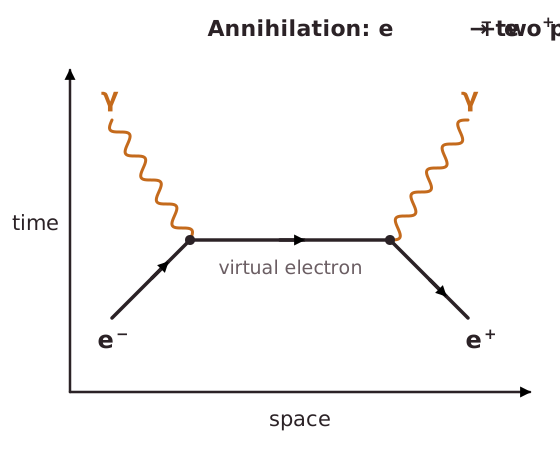
In radioactive decay, energy is released. The total mass of all the decay products after the decay is less than the total mass of the nucleus before the decay as some of the mass has been converted to the energy released. The relationship between the energy released Q and the difference in mass Δm is that Q = Δmc2 where c is the speed of light in a vacuum.One atomic mass unit = 1.661 x 10⁻²⁷kg = 931.5 MeV. In alpha decay the energy is shared between the recoiling nucleus and the emitted alpha-particle. In beta-decay the energy is shared between the nucleus, the beta-particle, neutrino or anti-neutrino. In electron capture, the energy is transferred to the kinetic energy of the neutrino and an X-ray photon that is emitted.