The principle of conservation of momentum: in a closed system (one with no external resultant force), the total momentum before an interaction equals the total momentum after it.Because momentum is a vector, this applies to direction as well as size. In two dimensions it means:
• the vector sum of the momenta before = the vector sum of the momenta after
• equivalently, momentum is conserved separately in any two perpendicular directions (x and y)This applies to collisions, where objects hit and may stick together or bounce apart, and to explosions, where objects start together and fly apart. An object at rest that explodes has zero total momentum, so the momenta of the pieces must add up to zero.A vector diagram shows this clearly. Draw the momentum vectors before the interaction tip to tail: their resultant is the total momentum. The momentum vectors after the interaction must add up to exactly the same resultant.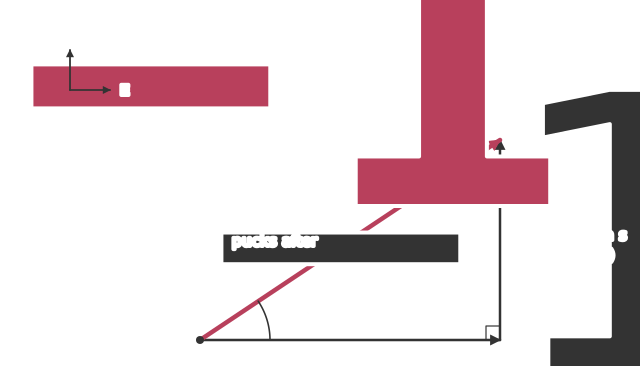
momentum east = 2.0 × 3.0 = 6.0 kg m s-1
momentum north = 1.0 × 4.0 = 4.0 kg m s-1
These are perpendicular, so the total momentum = √(6.02 + 4.02) = 7.2 kg m s-1, at tan-1(4.0 / 6.0) = 34° north of east.
Afterwards this momentum is carried by 3.0 kg, so v = 7.2 / 3.0 = 2.4 m s-1 at 34° north of east.
• the vector sum of the momenta before = the vector sum of the momenta after
• equivalently, momentum is conserved separately in any two perpendicular directions (x and y)This applies to collisions, where objects hit and may stick together or bounce apart, and to explosions, where objects start together and fly apart. An object at rest that explodes has zero total momentum, so the momenta of the pieces must add up to zero.A vector diagram shows this clearly. Draw the momentum vectors before the interaction tip to tail: their resultant is the total momentum. The momentum vectors after the interaction must add up to exactly the same resultant.
momentum east = 2.0 × 3.0 = 6.0 kg m s-1
momentum north = 1.0 × 4.0 = 4.0 kg m s-1
These are perpendicular, so the total momentum = √(6.02 + 4.02) = 7.2 kg m s-1, at tan-1(4.0 / 6.0) = 34° north of east.
Afterwards this momentum is carried by 3.0 kg, so v = 7.2 / 3.0 = 2.4 m s-1 at 34° north of east.