Skip to content

The Mass Spectrometer

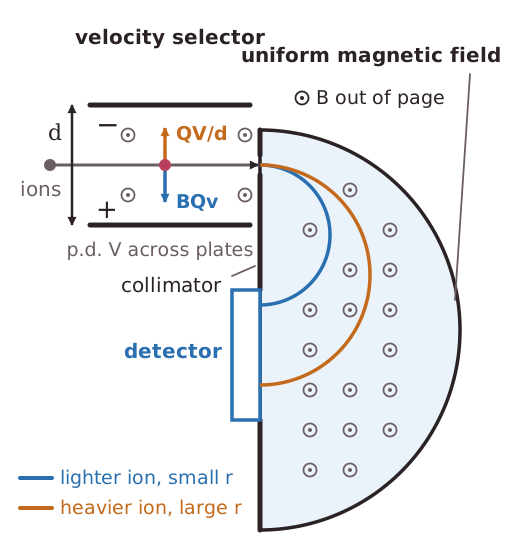
The mass spectrometer separates ions by mass using a velocity selector - a magnet and a pair of parallel plates with a high potential difference. The force due to the electric field F = QV/d is made equal and opposite to the force due to the magnetic field F = BQv so that any ions moving at a particular velocity v where BQv = QV/d are undeflected and can pass through the gap in the collimator. All ions emerge from the collimator with the same speed and enter a magnetic field where they travel a circular path. The radius of the path depends on their mass since r = mv/BQ.
Read the text

Read the text and highlight anything you think is important. When you go on, the text is hidden and you answer from memory.

Specification: AQA Physics (7408), A-level, 3.7.5.2 Moving charges in a magnetic field. Topic: Magnetic Fields.

Key terms in this lesson

positron
The antiparticle of the electron: a particle with the same mass as an electron but a positive charge, emitted during beta-plus decay.
neutrino
An uncharged particle with negligible mass, emitted along with a beta particle in radioactive decay to conserve energy and momentum.

More in Magnetic Fields

All 8 lessons in Magnetic Fields · All AQA A-level Physics topics