 BRAINCAKE
Force on a current-carrying wire
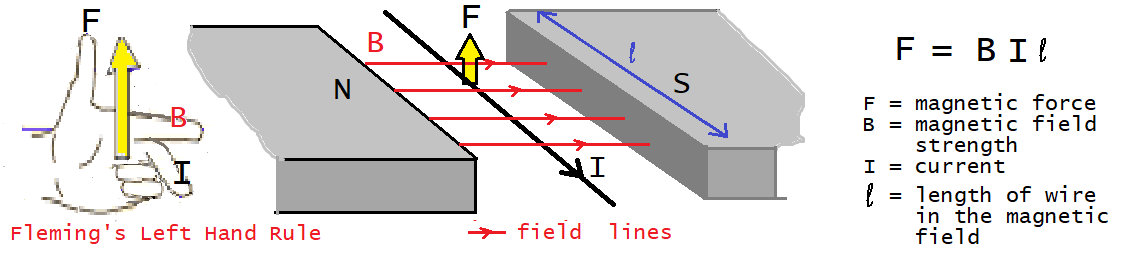
A wire carrying a current experiences a force in an external magnetic field. This is because the magnetic field around the wire due to the current interacts with the external magnetic field. This is known as the motor effect. The magnitude of the force is proportional to the size of the current I, the strength of the magnetic field B (magnetic flux density) and the length of the wire in the magnetic field l. The direction of the force can be found using Fleming's left hand rule and is at right angles to both the magnetic field and the current.
Sign in free to see the rest of this lesson, the R.E.C.I.P.E. recall steps and the quiz
BrainCake is free. Make an account in seconds and pick up where this page stops.
Key terms in this lesson
- Magnetic flux density
- The force per unit current per unit length on a current-carrying wire placed at right angles to a magnetic field, measured in tesla.
- Magnetic flux
- The product of the magnetic flux density and the area through which the field passes at right angles to it, measured in weber.
More in Magnetic Fields
- Magnetic Field
- Magnetic Flux density
- Couple on a coil in a magnetic field
- An Electric Motor
- Force on a moving Charge in a Magnetic Field
- Cyclotron
- The Mass Spectrometer
All 8 lessons in Magnetic Fields · All AQA A-level Physics topics