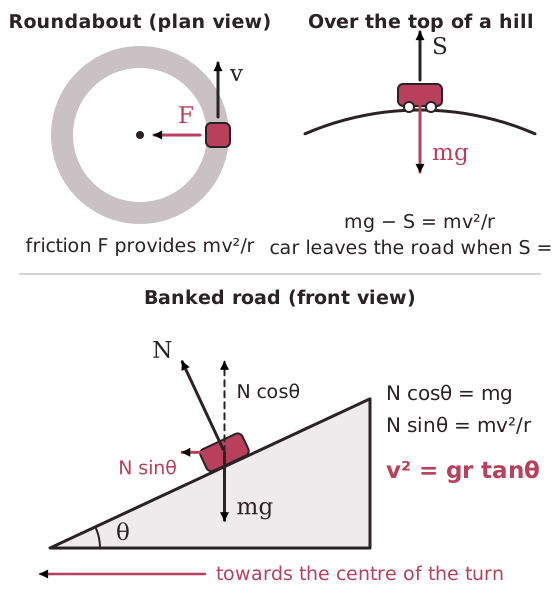
A car going round a roundabout experiences a force towards the centre of the roundabout. This force is provided by friction in the tyres.Limiting friction is proportional to the normal contact force, which on a flat road equals the car's weight: F = μmg where mg is the weight. So μmg must be greater than or equal to mv2/r. So v cannot be greater than √(μgr). Over the top of a hill the centripetal force F = mg - S = mv2/r where s is the normal contact force. S is zero when g = v2/r and the car loses contact with the road.On a banked road, the horizontal component of the normal reaction provides the centripetal force. v2 = gr tanθ so if the speed exceeds a certain value the radius has to increase and the car will move outwards.