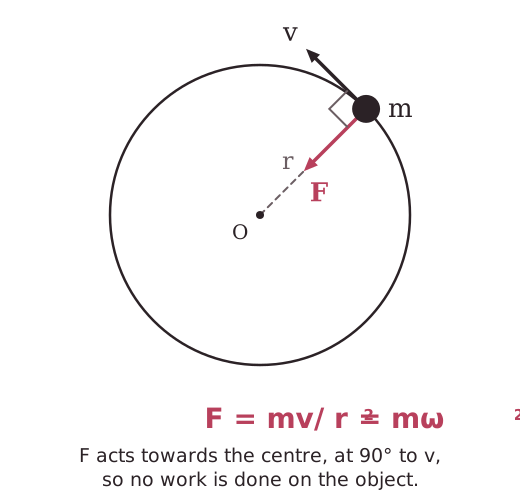
Applying Newton's second law F = ma to the centripetal acceleration gives F = mv2/rSince v = r ω , the centripetal force
According to Newtons second law, the centripetal force is proportional to the centripetal acceleration and takes place in the same direction i.e. towards the centre of the circle.Note that the object does not travel in the direction of the force. The centripetal force is perpendicular to the direction of motion so as there is no component of the force in the direction of motion there is no work done on the object by the centripetal force. Since no work is done, the object does not gain kinetic energy and maintains a constant speed.