 BRAINCAKE
A Capacitor
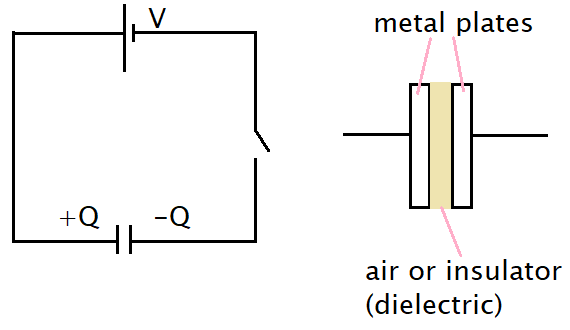
A capacitor is a component that stores charge. It consists of two metal or conducting plates separated by air or an insulator known as a dielectric. When a capacitor is connected to a cell or battery, one plate loses charge and becomes positive with a charge of +Q and the other gains the charge of -Q, so that the charge stored on the capacitor is Q.
Sign in free to see the rest of this lesson, the R.E.C.I.P.E. recall steps and the quiz
BrainCake is free. Make an account in seconds and pick up where this page stops.
More in Capacitors
- Charging a Capacitor and Constant Current
- Capacitance
- Use of Capacitors
- Energy Stored in a Charged Capacitor
- Measuring the Energy Stored in a Charged Capacitor.
- Energy stored in a Thundercloud
- Discharging a Capacitor through a Fixed Resistor
- Exponential Decay.
All 12 lessons in Capacitors · All AQA A-level Physics topics