The peak wavelength of a black-body curve, λmax, depends only on the temperature. Wien's displacement law states:λmax T = 2.9 × 10⁻³ m K where λmax is in metres and T is the absolute temperature in kelvin. So λmax is inversely proportional to T: doubling the temperature halves the peak wavelength.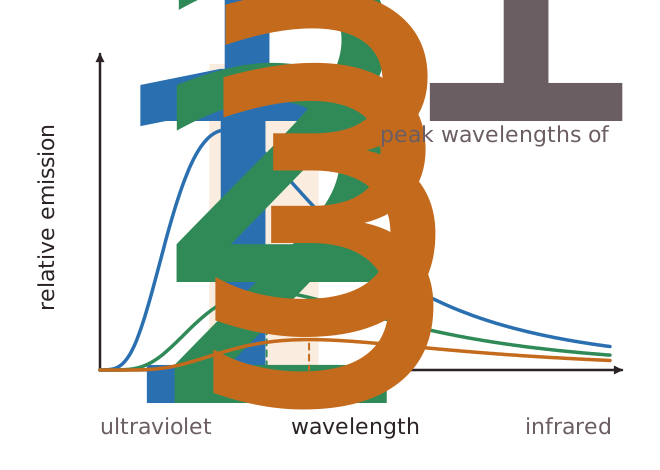 Astronomers measure λmax from a star's spectrum and use Wien's law to find its surface temperature. This works because stars behave approximately as black bodies.Worked example 1: the Sun's spectrum peaks at about 500 nm. Find its surface temperature.
T = 2.9 × 10⁻³ / (500 × 10-9) = 5800 KWorked example 2: find λmax for a star at 12 000 K.
λmax = 2.9 × 10⁻³ / 12 000 = 2.4 × 10⁻⁷ m = 240 nm, in the ultraviolet. The star emits more blue than red visible light, so it looks blue-white.Common mistakes: forgetting to convert nm to m (1 nm = 10-9 m), or using °C instead of kelvin. Remember that λmax is the wavelength of the peak intensity, not the only wavelength emitted: the star emits a continuous spectrum.
Astronomers measure λmax from a star's spectrum and use Wien's law to find its surface temperature. This works because stars behave approximately as black bodies.Worked example 1: the Sun's spectrum peaks at about 500 nm. Find its surface temperature.T = 2.9 × 10⁻³ / (500 × 10-9) = 5800 KWorked example 2: find λmax for a star at 12 000 K.
λmax = 2.9 × 10⁻³ / 12 000 = 2.4 × 10⁻⁷ m = 240 nm, in the ultraviolet. The star emits more blue than red visible light, so it looks blue-white.Common mistakes: forgetting to convert nm to m (1 nm = 10-9 m), or using °C instead of kelvin. Remember that λmax is the wavelength of the peak intensity, not the only wavelength emitted: the star emits a continuous spectrum.