Skip to content

Free Radical Substitution

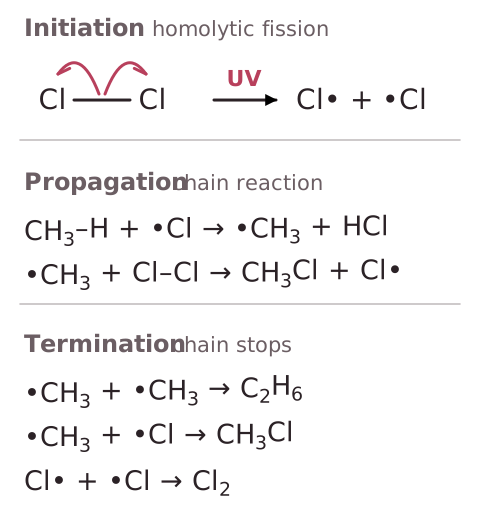
The halogenation of alkanes takes place by a mechanism called free radical substitution and can be considered to take place in three steps:
  • initiation
  • propagation
  • termination
Initiation involves the homolytic fission of a Cl-Cl bond by ultraviolet radiation (photodissociation). The Cl radicals formed are very reactive and remove a hydrogen when they collide with an alkane molecule. This gives an alkyl radical which breaks a Cl-Cl bond releasing a Cl radical i.e. a chain reaction. Termination occurs when two radicals react together to form a molecule, removing radicals from the chain.

Read the text

Read the text and highlight anything you think is important. When you go on, the text is hidden and you answer from memory.

Specification: OCR Chemistry A (H432), A-level, 4.1.2 Alkanes. Topic: Alkanes.

Key terms in this lesson

free radical
A species with an unpaired electron.
homolytic fission
The breaking of a covalent bond in which each bonding atom takes one electron from the bonded pair, forming two free radicals.

More in Alkanes

All 8 lessons in Alkanes · All OCR A-level Organic Chemistry topics