 BRAINCAKE
Cracking and Reforming
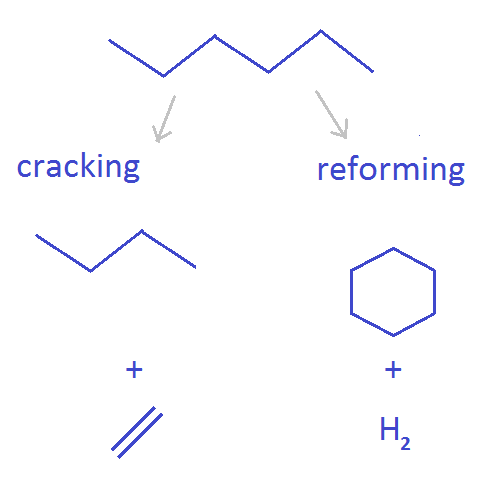
Shorter chain alkanes, branched and cyclic hydrocarbons are better fuels as they undergo more efficient combustion. Since the demand for short-chain, branched and cyclic hydrocarbons exceeds the supply whilst there is a surplus of longer, straight-chain hydrocarbons, longer-chain hydrocarbons are converted into shorter-chain hydrocarbons by thermal or catalytic cracking, and straight-chain hydrocarbons into branched or cyclic hydrocarbons by reforming.
Sign in free to see the rest of this lesson, the R.E.C.I.P.E. recall steps and the quiz
BrainCake is free. Make an account in seconds and pick up where this page stops.
Key terms in this lesson
- cracking
- The breakdown of longer-chain hydrocarbons into shorter-chain hydrocarbons, including at least one alkene, using heat and often a catalyst.
- reforming
- The conversion of straight-chain alkanes into branched-chain or cyclic alkanes, usually using a platinum catalyst.
More in Alkanes
- Crude Oil
- Complete Combustion
- Incomplete Combustion
- Oxides of Sulfur and Nitrogen
- Catalytic Converters
- Alternative Fuels
- Free Radical Substitution
All 8 lessons in Alkanes · All OCR A-level Organic Chemistry topics