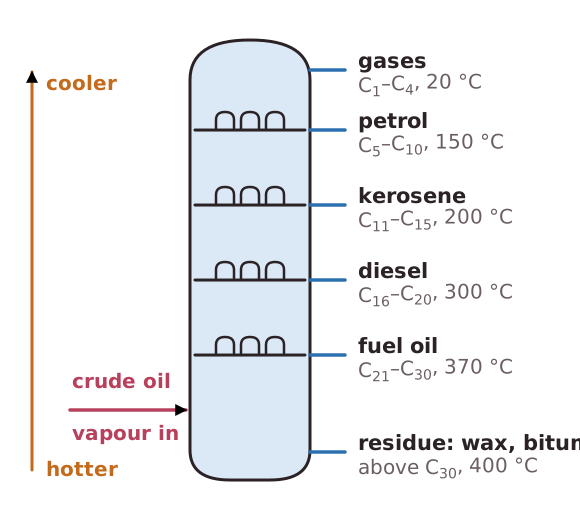
Most of the energy used worldwide comes from coal, crude oil and natural gas. Crude oil is a mixture of mostly hydrocarbons - mostly alkanes. It is converted into a small number of fractions by fractional distillation.Crude oil vapour is passed into the bottom of a fractionating column which has a temperature gradient and is cooler at the top than at the bottom. The vapour rises up the column through a series of bubble caps and condenses at different heights where the temperature matches the temperature range of the molecules in the fraction. Smaller molecules condense at lower temperatures.
Crude Oil
Read the text
Read the text and highlight anything you think is important. When you go on, the text is hidden and you answer from memory.
Specification: OCR Chemistry A (H432), A-level, 4.1.2 Alkanes. Topic: Alkanes.
Key terms in this lesson
- fractional distillation
- The separation of a mixture of liquids into fractions with different boiling ranges, by evaporation and condensation in a fractionating column.
More in Alkanes
- Cracking and Reforming
- Complete Combustion
- Incomplete Combustion
- Oxides of Sulfur and Nitrogen
- Catalytic Converters
- Alternative Fuels
- Free Radical Substitution
All 8 lessons in Alkanes · All OCR A-level Organic Chemistry topics