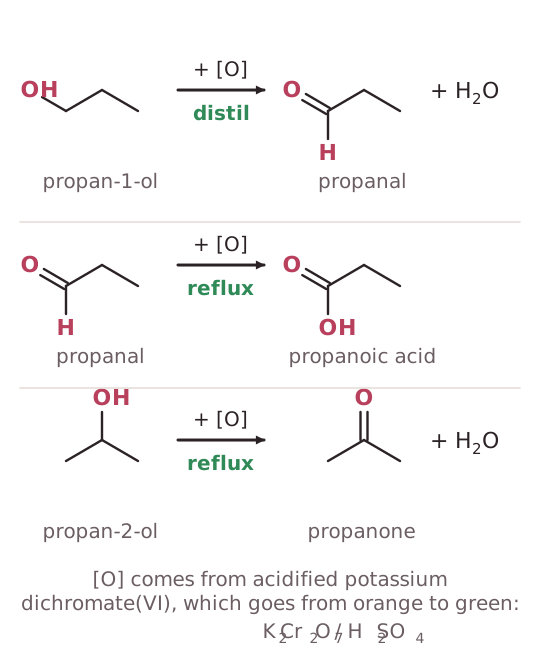
Primary and secondary alcohols can be oxidised using potassium dichromate VI and sulfuric acid (K2Cr2O7/H2SO4).The primary alcohol is oxidised into an aldehyde on gentle heating and water is an additional product. The aldehyde can be distilled out as it formed to prevent further oxidation. Further oxidation of the aldehyde to a carboxylic acid occurs if the mixture is heated under reflux.Secondary alcohols are oxidised to ketones if heated under reflux. Tertiary alcohols will not react.In the reaction the acidified dichromate: H+/Cr2O72- goes from orange to green Cr3+.
Oxidation
Read the text
Read the text and highlight anything you think is important. When you go on, the text is hidden and you answer from memory.
Specification: OCR Chemistry A (H432), A-level, 4.2.1 Alcohols. Topic: Alcohols.
Key terms in this lesson
- oxidation
- A reaction in which hydrogen atoms are removed from, or oxygen atoms are added to, an organic molecule.
- primary alcohol
- An alcohol in which the -OH group is attached to a carbon atom bonded to only one alkyl group.
- secondary alcohol
- An alcohol in which the -OH group is attached to a carbon atom bonded to two alkyl groups.
- tertiary alcohol
- An alcohol in which the -OH group is attached to a carbon atom bonded to three alkyl groups.
More in Alcohols
- Alcohols
- Physical Properties
- Classifying Alcohols
- Combustion and use as Fuels
- Dehydration of Alcohols
- Nucleophilic Substitution Reactions
All 7 lessons in Alcohols · All OCR A-level Organic Chemistry topics