Skip to content

Dehydration of Alcohols

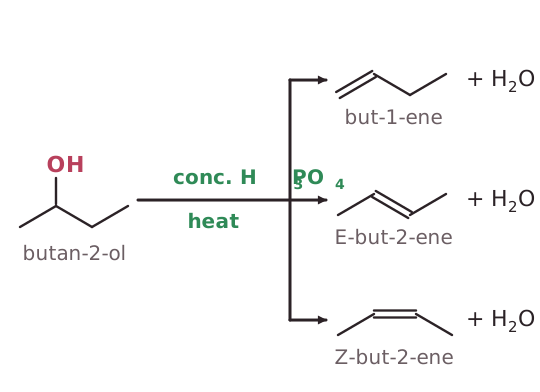
On heating an alcohol with concentrated phosphoric acid H3PO4, an elimination reaction occurs. A molecule of water is eliminated and an alkene is formed. This reaction is also known as dehydration.For some alcohols with more than three carbon atoms, there may be more than one possible product due to the positional isomerism of the double bond forming between different carbon atoms, and E-Z isomerism due to the presence of a double bond.The dehydration of butan-2-ol is as follows:CH3CH(OH)CH2CH3 → CH2=CHCH2CH3 + H2OCH3CH(OH)CH2CH3 → CH3CH=CHCH3 + H2O
Read the text

Read the text and highlight anything you think is important. When you go on, the text is hidden and you answer from memory.

Specification: OCR Chemistry A (H432), A-level, 4.2.1 Alcohols. Topic: Alcohols.

Key terms in this lesson

elimination
A reaction in which atoms or a small molecule are removed from a molecule, often forming a double bond.
position isomerism
Structural isomerism in which compounds have the same molecular formula but the functional group is in a different position.
E-Z isomerism
A system for naming geometric isomers, in which the two isomers are distinguished by the priority (atomic number) of the groups attached to each carbon of the double bond.

More in Alcohols

All 7 lessons in Alcohols · All OCR A-level Organic Chemistry topics