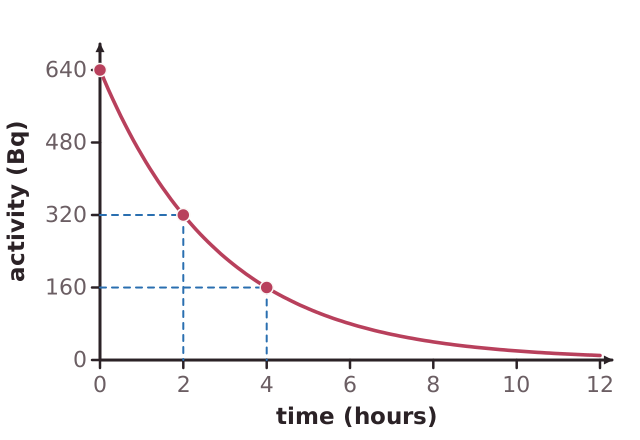
After each half-life the activity (or the number of unstable nuclei) halves again. After one half-life one half is left, after two half-lives one quarter is left, after three half-lives one eighth is left, and after four half-lives one sixteenth is left (1/16). In general, after n half-lives the fraction remaining is 1 divided by 2 multiplied by itself n times.
The net decline can be written as a ratio of the amount remaining to the starting amount. One half-life gives 1 : 2, two half-lives give 1 : 4, three give 1 : 8 and four give 1 : 16. Always count the half-lives first, then halve that many times.
Worked example: a source has an activity of 640 Bq and a half-life of 2 hours. After 6 hours, that is 3 half-lives, the activity goes 640, 320, 160, 80 Bq. The ratio of remaining to starting activity is 80 : 640, which is 1 : 8.
On a graph of activity against time the curve falls steeply and then flattens. To find the half-life, read the time at which the activity has halved from its starting value. The time for it to halve again, from the half value to a quarter, is the same, because each is one half-life.