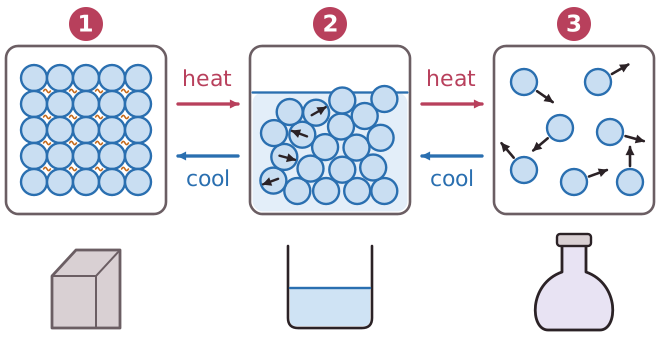
The particle model explains the three states of matter by picturing every substance as made of tiny particles. In a solid the particles are packed closely together in a regular pattern. They are held in place by strong forces of attraction, so they can only vibrate about fixed positions. A solid keeps its shape and cannot be poured.
In a liquid the particles are still close together and touching, but they are arranged randomly and can move past each other. This is why a liquid flows and takes the shape of its container, but cannot easily be squashed. In a gas the particles are far apart and move quickly in random directions. The forces between them are very weak, so a gas spreads out to fill its container and can be compressed.
A change of state happens when energy is transferred to or from a substance. Heating a solid gives its particles more energy until they break free of their fixed positions and it melts. Further heating makes the liquid boil or evaporate to a gas. Cooling reverses this: a gas condenses to a liquid and a liquid freezes to a solid. The particles themselves do not change, only their arrangement and movement, so a change of state is reversible and the mass stays the same.