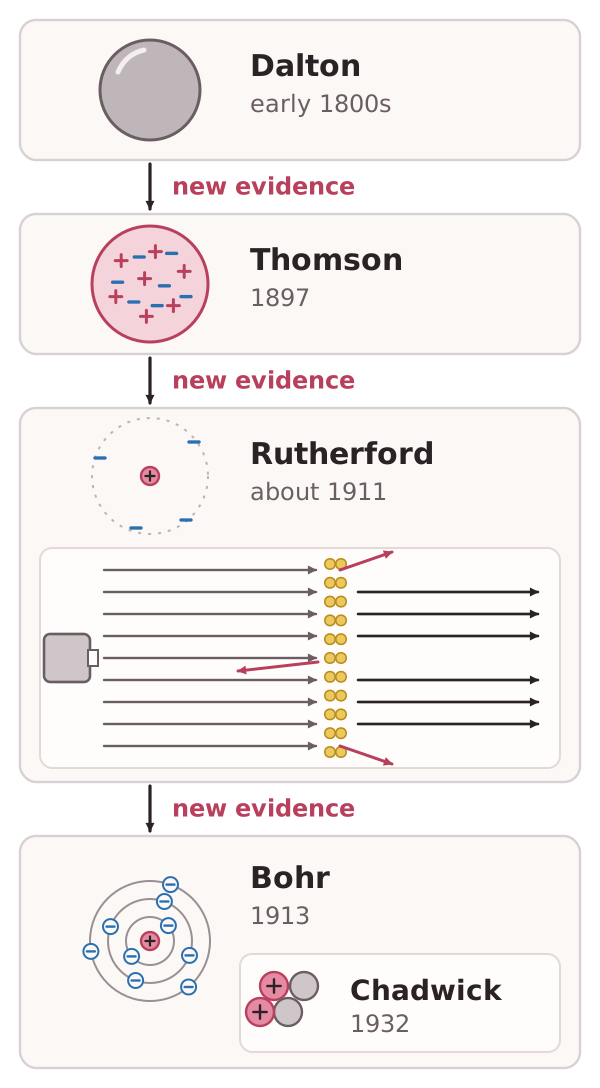
Scientists change a model when new evidence does not fit the old one. In the early 1800s John Dalton pictured atoms as tiny, solid spheres that could not be divided, with a different sphere for each element.
In 1897 J. J. Thomson discovered the electron, which showed that atoms are not indivisible. His plum pudding model had the atom as a ball of positive charge with negative electrons embedded in it, like plums in a pudding.
Hans Geiger and Ernest Marsden fired alpha particles at thin gold foil. Most went straight through, a few were deflected through large angles, and a very small number bounced almost straight back. The plum pudding model could not explain this. Ernest Rutherford used the results to propose the nuclear model: a tiny, dense, positively charged nucleus at the centre, with the electrons outside it. Most alpha particles passed through because most of the atom is empty space.
Niels Bohr then improved the model. He suggested that electrons orbit the nucleus only at certain fixed distances, in shells (energy levels). This explained results that the nuclear model could not, and it is the model you use today.