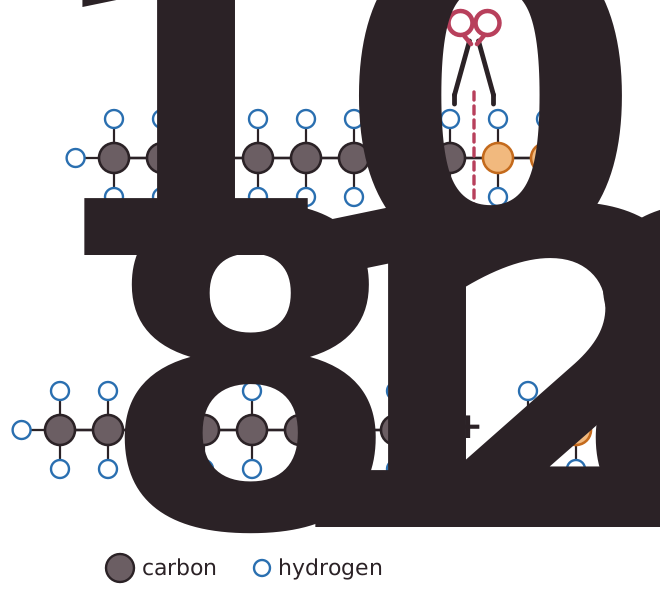
Fractional distillation gives more long-chain hydrocarbons than industry needs, and fewer short-chain ones, which are more useful as fuels. Long molecules are thick and hard to ignite, while short molecules are runny and burn easily. Cracking turns the surplus long-chain hydrocarbons into shorter, more useful molecules.
In cracking, a long-chain alkane is broken down by heating it to vaporise it and passing the vapour over a hot catalyst, such as aluminium oxide, at about 600 to 700 °C. Another method is steam cracking, where the hydrocarbon is mixed with steam and heated to a high temperature. Cracking is a thermal decomposition reaction because heat breaks the molecule into smaller pieces.
The products are a shorter alkane and an alkene. Alkenes are hydrocarbons with a carbon-carbon double bond, so they are unsaturated and more reactive than alkanes. For example, decane can be cracked: C10H22 → C8H18 + C2H4. The shorter alkane, such as octane, is used in petrol. The alkene, ethene, is a raw material for making polymers such as poly(ethene), and it is also used to make other chemicals.